Which material to choose for a returnable tray or cradle: strength, temperature and contact with the part
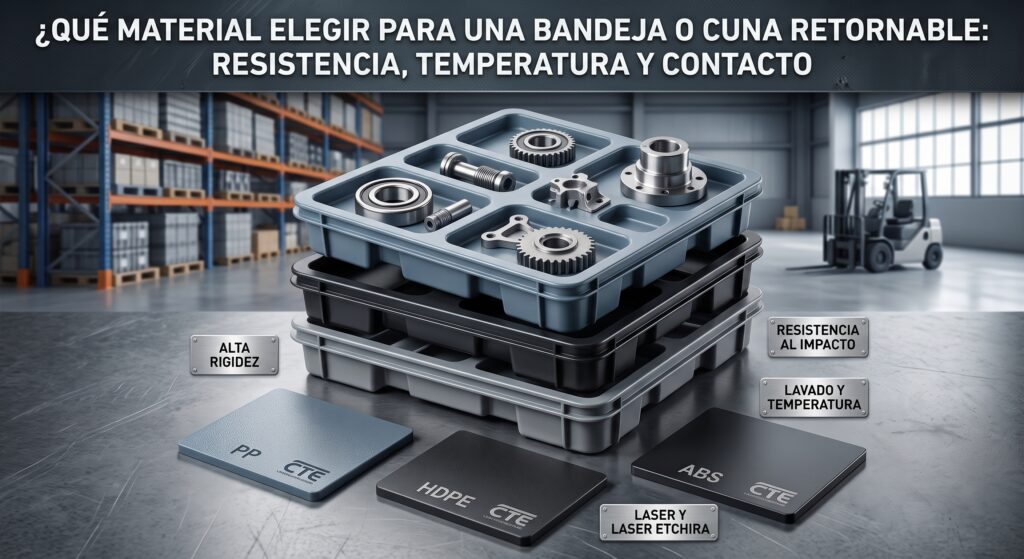
When a company decides to move from single-use cardboard or wood to thermoformed returnable packaging, the first question is usually the design: what shape, how many parts per tray, how it stacks. But the decision that most conditions the packaging’s service life, and therefore its profitability, is another: what material we manufacture it from.
There is no “best” plastic in the abstract. There is the right material for a specific use. And that use is defined with three questions.
1. What does it have to withstand?
Returnable packaging lives a hard life: forklift impacts, stacked loads, loading and unloading cycles hundreds of times, often in a hurry. Here two properties that are sometimes confused must be distinguished:
- Rigidity: that the tray does not flex under load, maintains geometry and stacks well. It matters when the part is heavy or when the nest has to position with precision (for example, for automatic loading on the line).
- Impact resistance: that it does not crack with a blow or a drop. It matters in intensive internal logistics and in shipments with many handlings.
A material can be very rigid and brittle (polystyrene) or very tough and not very rigid (polyethylene). Design compensates for part of this difference with ribs, double walls and thicknesses, but the starting point is set by the material.
2. At what temperature will it operate?
It is the question most often forgotten and the one that breaks the most packaging. Three common scenarios:
- Cold: winter transport, unheated warehouses, shipments to northern Europe. Some materials become brittle below 0 °C. A tray that works perfectly in the plant may arrive cracked after a night on a dock at -5 °C.
- Heat: parts that come out of a drying oven, a painting process or an injection molding machine and are placed in the tray still hot. Also closed trucks in the sun in summer.
- Washing: if the tray is cleaned between cycles (common in food, pharma or components with cleanliness requirements), hot water and detergents determine the material.
If the packaging only lives in a temperate plant, almost any material will do. If it will go through extremes, temperature is the number one filter.
3. What part goes inside?
Returnable packaging exists so that the part arrives the same as it left. Contact between plastic and part raises several issues:
- Scratching and marking: painted, lacquered, chrome-plated or polished surfaces need a material that does not mark them under transport vibration. Sometimes it is resolved with the material, sometimes with a textured finish or with a foam or felt liner in the nest.
- Chemical compatibility: parts with oils, cutting fluids, solvent residues or adhesives. Some plastics absorb or degrade; others are practically inert.
- Electronics: boards and sensitive components require materials with antistatic or dissipative charge (ESD).
- Food or healthcare: raw material with food-contact suitability certification and easy-to-wash surfaces are required.
The usual materials, one by one
Polypropylene (PP) The workhorse of returnable packaging. Good balance of rigidity, chemical resistance, lightness and price. It withstands heat well (up to about 90–100 °C in continuous use, so it supports washing) and is among the easiest to recycle. Its weak point is cold: below 0 °C it loses toughness and can crack with a blow. Copolymer grades exist that greatly improve this behavior.
High-density polyethylene (HDPE) The toughest on the list and the one that best withstands cold (no problem down to -40 °C). Highly resistant to chemicals, oils and moisture, and very hard to break. In return, it is less rigid than PP and has a lower use temperature (it starts to deform above 70–80 °C). It is the usual choice for trays that will take a lot of abuse or travel in the cold, and for parts with oil residues.
ABS The most “engineering” of the usual ones. It combines high rigidity with very good impact resistance, also at moderately low temperatures, and offers an excellent surface finish, with texturing options and stable colors. The trade-offs are a higher price and lower chemical resistance than PP and HDPE (solvents attack it). It is the option when the tray has to position with precision, integrate into automation or present a good image to the end customer.
High-impact polystyrene (HIPS) Economical, rigid and easy to thermoform with a lot of detail. Its impact resistance is adequate but lower than ABS and HDPE, and it tolerates cold and solvents poorly. It is widely used in short-rotation trays, separators and applications where price rules and conditions are controlled.
PETG Transparent, with good impact resistance and cold tolerance, and suitable for food contact. It allows the contents to be seen without opening, something highly valued in visual inspection and in healthcare. Its limit is heat (above 60–65 °C it deforms) and its sensitivity to some chemicals. It costs more than PP or HIPS.
Polycarbonate (PC) When nothing else holds up: very high impact resistance, continuous use up to about 120 °C and transparency. It is expensive and scratches easily, so it is reserved for very specific demanding applications.
Any of these materials can be manufactured with antistatic or ESD additives for electronics, in recycled material grades (very common in PP and HDPE, with cost savings and a better environmental footprint) and in coextruded sheets that combine a resistant outer layer with a soft-contact inner layer.
Quick guide
| Main need | Starting material |
|---|---|
| General use, good balance and washing | PP |
| Cold, strong impacts, parts with oil | HDPE |
| Precision, automation, image | ABS |
| Minimum cost in controlled conditions | HIPS |
| See the contents, food contact | PETG |
| High heat and maximum toughness | PC |
One last recommendation
The material is chosen with the part in hand and knowing the real packaging circuit: where it is filled, how it travels, where it is stored, how many rotations are expected and whether it is washed. With that information, a thermoforming manufacturer can propose not only the material but the sheet thickness, finish type and nest design that go together. Choosing well at the start is what turns a tray into packaging that lasts hundreds of cycles instead of dozens.
At CTE we manufacture custom returnable trays, cradles and separators in all these materials. If you have a part to package and are unsure about the material, tell us about the case and we will study it with you.