By Jesús Longas ·
The tray is designed last, and it shows
In many projects, the tray is the last thing to be defined. The part has already been approved, the production line is already set up, and the packaging has to adapt to everything.
The result is trays that protect the product but don’t fit in the box, can’t be stacked when full, or aren’t read correctly by the robot. And a mold that’s already been manufactured is expensive to change.
Here are the seven mistakes we see most often—and how to avoid them from the start.
The 7 Mistakes
1. Designing the tray without considering the box
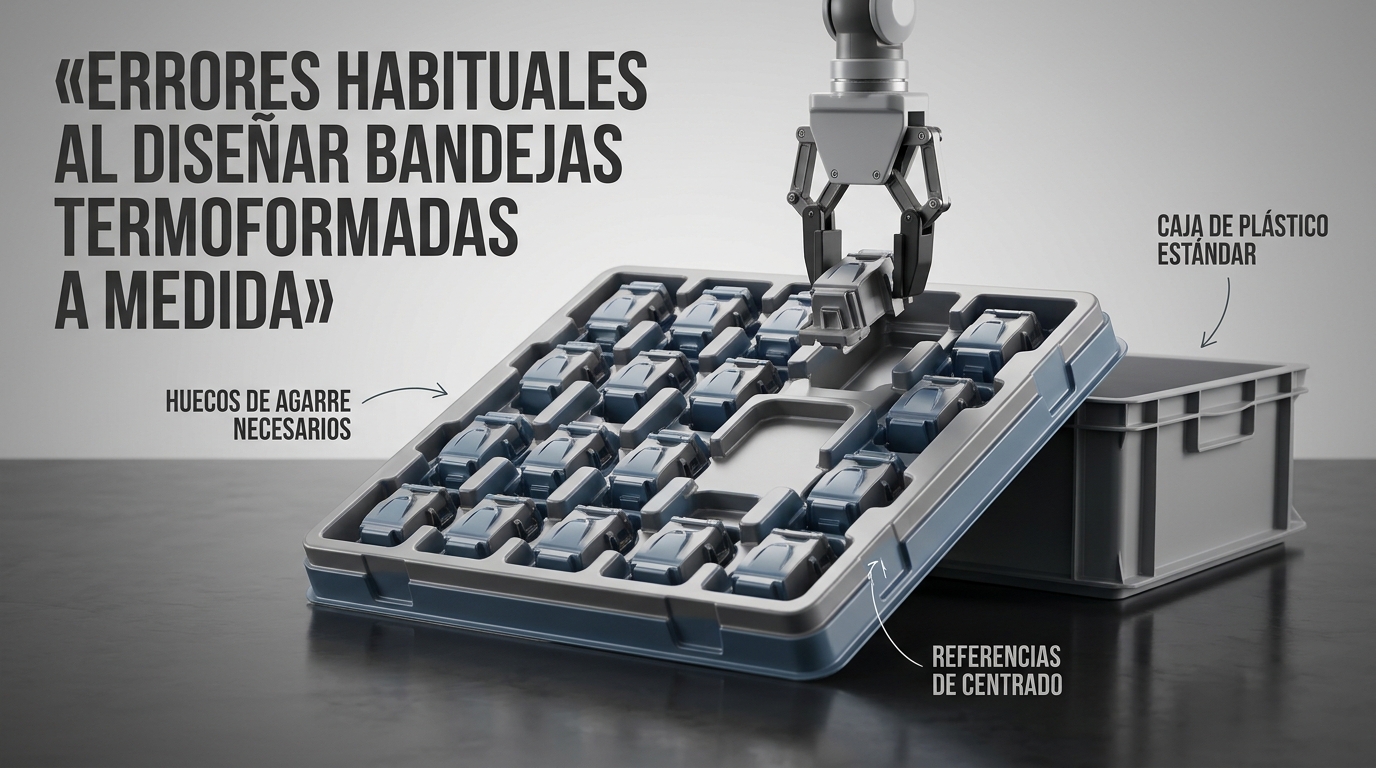
The tray almost never travels alone. It goes inside a standard plastic box, a container, or a cart. If its dimensions don’t fit the usable interior of that container, there’s wasted space and the trays shift around.
The correct approach is to start with the container the plant already uses—for example, boxes measuring 600 × 400 mm or their submultiples—and design the tray to fit that space, with just enough clearance to slide it in and out.
2. Confusing “stackable” with “nestable”
A stackable tray can support other trays on top of it when it is full. A nestable tray fits inside another when it is empty, so that returned trays take up only a fraction of the volume.
Both features can be achieved simultaneously, for example, by rotating the tray 180° depending on whether it is full or empty. But this must be decided before the mold is made. And it must be verified that the full stack can support the weight without deforming.
3. Compartments That Are Too Tight or Too Loose
If the cell is too tight, the part is difficult to insert and remove, and it rubs against the sides. If it’s too loose, the part wobbles and bangs against the sides during transport.
Proper fitting takes into account the tolerances of the part itself and those of the thermoformed component. It should support the part in functional areas, never on visible, painted, or machined surfaces.
4. Forgetting how to grip the part
A tray that’s perfect for protection may be impractical on the workstation. If the operator has no room for their fingers, or the robot’s gripper can’t reach, time is wasted on each part.
You must ask who removes the part and how: by hand, with a glove, with a gripper, or with a suction cup. And leave the necessary grip openings.
5. Not taking automation into account
If the tray feeds a robot or a machine vision system, the part must always be in the same position. This requires centering references on the tray, good flatness, and sufficient rigidity to prevent flexing.
A tray designed solely for manual handling rarely works later in a robotic cell.
6. Ignoring static electricity and cleanliness
For electronic components, standard plastic can accumulate a charge and damage them. In such cases, dissipative or conductive materials must be used, depending on the ESD protection standard in effect at the facility.
In sectors with cleanliness requirements, the tray must be washable without corners where dirt can accumulate. This also dictates the tray’s geometry.
7. Failing to identify the tray
When a plant has several similar part numbers, the trays end up getting mixed up. It’s advisable to include, right from the design stage, part number marking, a slot for a label or RFID tag, and material identification for recycling at the end of its life.
Before Requesting a Quote
With this information, any manufacturer can propose a tray that works right from the start:
- Drawing or 3D model of the part, showing its weight and areas that must not be touched
- Container or box that will hold the tray, with interior dimensions
- Number of parts per tray and number of trays per box required
- Whether it is stacked when full, nested when empty, or both
- Who loads and unloads the part: operator, robot, or both
- Special requirements: ESD, washing, temperature, contact with oils
- Annual volume and expected duration of the program
- Route: where it travels from, where it goes, and how it returns
Let’s design the tray in tandem with the process
At CTE, we’ve been thermoforming technical parts and industrial packaging for decades. We design the tray based on your part, your container, and your workflow, and we manufacture the mold in-house.
This allows us to quickly adjust the design and validate it with prototypes before committing to mass production.
Send us the drawing of your part, and we’ll propose a tray.