By Jesús Longas ·
You will be asked for packaging “in accordance with ATA 300”
If you manufacture or transport aircraft parts, sooner or later you’ll be asked for packaging “in accordance with ATA 300.” Sometimes the airline requests it. Other times, it’s the aircraft manufacturer or a Tier 1 supplier, as part of their supplier specifications.
This guide explains what the specification is, what its three categories mean, and what’s involved in designing a Category I container—one that’s reused at least 100 times.
What Is ATA Spec 300
ATA Spec 300 is the packaging specification for aircraft supplies. It was first published in 1960 by the Air Transport Association, now known as Airlines for America (A4A). It was drafted by a committee of airlines to standardize how parts and spare parts are packaged as they move between airlines, maintenance shops, and suppliers.
Over time, it has become the industry standard. Many leading manufacturers and suppliers cite it in their packaging requirements, although they often add their own specific requirements.
The specification covers packaging design, testing, marking, and identification. It also includes a chapter on electrostatic discharge (ESD) protection for electronic components.
The three categories
| Categoría | Uso previsto | Ejemplos típicos |
| Categoría I | Reutilizable, mínimo 100 viajes de ida y vuelta | Contenedores de plástico técnico, GRP, rotomoldeados o metálicos |
| Categoría II | Reutilizable, mínimo 10 viajes de ida y vuelta | Cajas reforzadas de vida media |
| Categoría III | Un solo viaje (incluido el retorno de la pieza sustituida) | Cartón ondulado de alta resistencia |
Category is not simply declared—it must be demonstrated. Category I and II containers must be tested on a pre-production prototype and on a sample from the first production run.
Category I Requirements
Category I is the most demanding. The tests include stacking, drop or impact, and water resistance. Additionally, only in this category are vibration and penetration tests required.
In practice, this requires designing the container from the outset with five criteria in mind:
- Resistencia sostenida. No basta con que aguante un envío. Tiene que llegar al viaje 100 protegiendo igual que el primero. Los materiales que se aplastan o pierden propiedades con el uso, como muchas espumas, se quedan cortos.
- Protección interior estable. La pieza debe ir sujeta e inmovilizada en cada viaje, sin depender de rellenos que se mueven, se rompen o se pierden.
- Reparabilidad. En 100 ciclos algo se va a dañar. Un buen diseño permite sustituir la parte afectada sin tirar el contenedor entero.
- Identificación duradera. Marcado y etiquetas que sobrevivan a los ciclos de uso y limpieza, y que permitan asociar el contenedor a la pieza que transporta.
- Documentación. Informe de ensayos que el cliente pueda incorporar a su sistema de calidad.
An important note: Many containers on the market that resemble a Category I container are referred to as “ATA boxes,” but they have not passed the tests required by the specification. Always request the test report.
Why This Affects You Even If You’re Not an Airline
The specification was originally created for airlines, but its rationale has extended to the entire supply chain. An aerostructures manufacturer that ships panels to the assembly line several times a week faces the same problem as an airline: frequent shipments, expensive parts, and packaging that ends up in the trash.
When the flow is repetitive, switching from Category III to Category I is no longer a technical requirement but becomes an economic decision. The container costs more initially, but it pays for itself in a number of shipments that is usually fewer than expected. From then on, each trip is practically free and produces no waste.
The challenge: one part, one container
The common problem with Category I in the aerospace industry is variety. Each part has a different geometry, and traditionally, each one ends up requiring its own container: a new design, a new mold, a new lead time, and new testing.
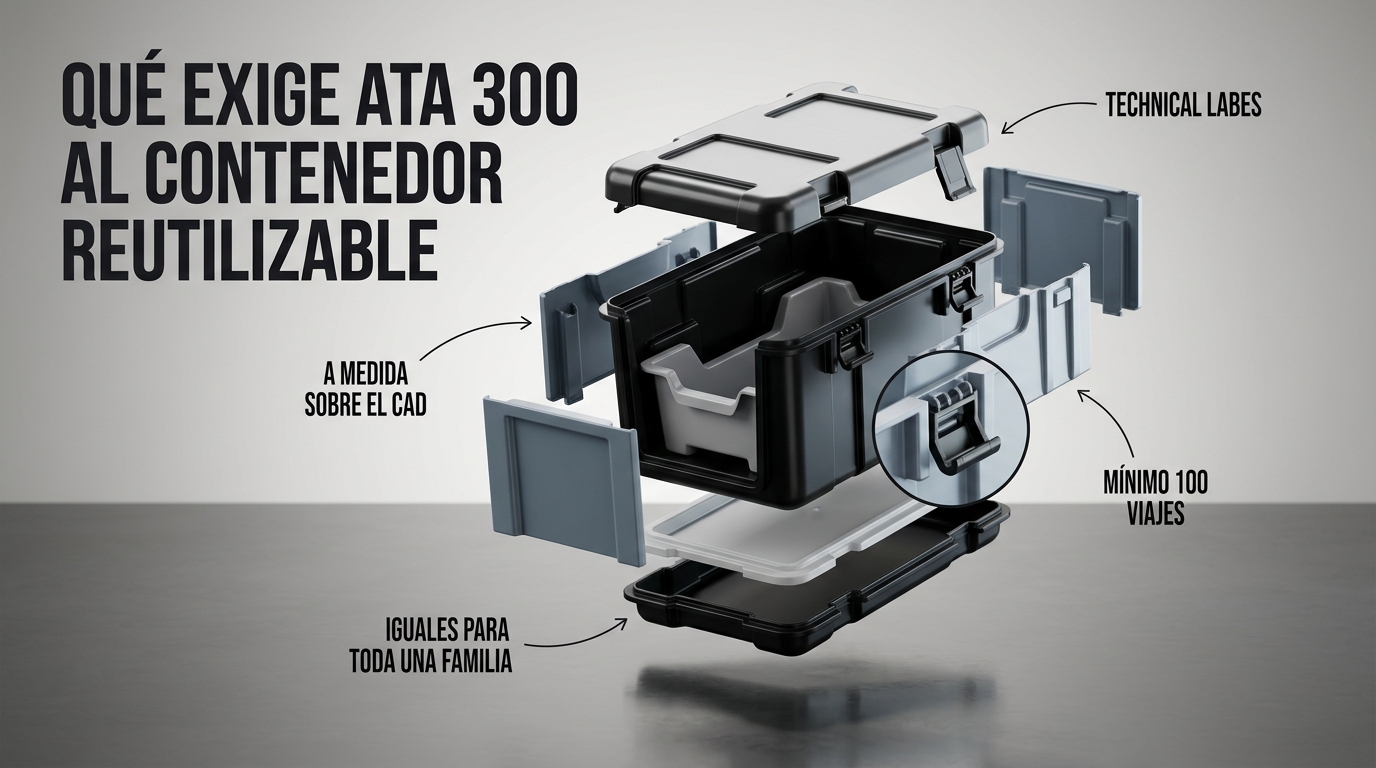
That’s why it makes sense to distinguish between what is common and what is specific. The base, walls, closures, and identification can be the same for an entire family of parts. Only the inner cradle needs to replicate the geometry of each part.
Thermoforming fits well into this framework: it allows for the production of custom-made cradles based on the part’s CAD model using tooling that is much cheaper and faster than injection molding or rotational molding. And an engineering thermoplastic does not produce fibers, splinters, or foam residue—a key factor in preventing foreign object debris (FOD).
If your parts are made of composite material, there’s one more reason to be careful with packaging. We explain this in “Invisible Damage in Composites (BVID): Why Packaging Is Part of the Problem.”
In summary
ATA Spec 300 defines three levels of packaging based on their service life. Category I, with a minimum of 100 trips, is the standard for repetitive flows of high-value parts and requires a design and testing regimen that meets these standards.
At CTE, we have been designing and manufacturing thermoformed returnable packaging for decades for the automotive, machinery, and defense industries, conducting drop, vibration, and stacking tests in collaboration with our technology partner.
Are you considering switching from single-use packaging to returnable packaging? Tell us what parts you’re shipping and how often. We’ll help you determine if it’s worth it.