By Jesús Longas ·
The Shopping Question
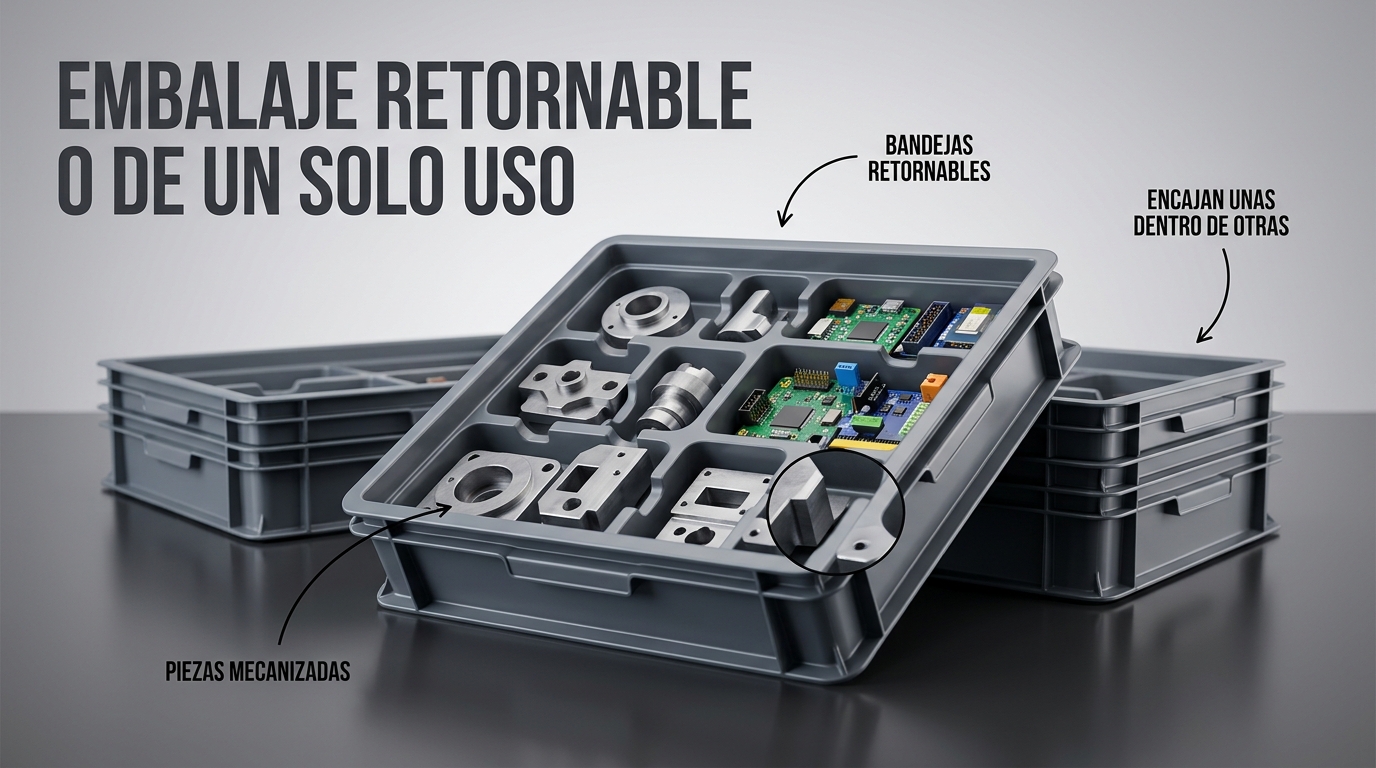
A reusable tray costs significantly more than one made of cardboard or foam. That’s the first thing the purchasing department sees—and it’s usually the last.
The correct comparison isn’t unit price versus unit price. It’s cost per trip versus cost per trip, over the entire lifespan of the packaging.
In this article, we explain what goes into each side of the equation, how to calculate the break-even point, and in which cases reusable packaging isn’t worth it.
The True Cost of Single-Use Packaging
The purchase price is only the visible part. Cardboard, foam, or wooden packaging also generates other costs that are rarely attributed to the packaging:
- Recurring purchase. You pay with each shipment, indefinitely.
- Assembly and unpacking. Folding boxes, placing shims, cutting strapping. These tasks take a few minutes of labor at each end of the process.
- Waste. Collection, compaction, containers, and waste management at the receiving facility.
- Warehouse. New packaging takes up space before it’s used.
- Damage to the part. A crushed cushioning piece or a box that absorbs moisture provides poorer protection during the final leg of transit. Every rejected or reworked part represents a packaging cost, even if it’s attributed to quality control.
When you add up these charges, the shipping cost is usually much higher than the price on the invoice.
The Cost of a Returnable System
Returnable packaging has a different cost structure: high up front and low afterward.
- Tooling. The thermoforming or injection mold. You pay for it once.
- Units. Each tray or container costs more than its disposable equivalent.
- Required inventory. The units in a single shipment aren’t enough. You need to cover the entire cycle: items in transit, at the customer’s location, on their way back, and in reserve.
- Return. Return shipping. If the trays nest inside one another when empty, this cost is significantly reduced.
- Cleaning and monitoring. Regular washing, inspection, and replacement of damaged or lost units.
The key lies in the fleet. A long route or one with a lot of intermediate inventory requires more vehicles, and that delays the payback period.
How to Calculate the Break-Even Point
The calculation fits on one line: the initial investment divided by the savings on each trip.
Here’s an example with approximate figures. A supplier ships 200 trays of parts per week to an assembly plant. The entire cycle takes about two weeks.
| Concept | Single-use | Returnable |
|---|---|---|
| Cost of packaging per shipment (€) | 2.80 | — |
| Setup and unpacking per shipment (€) | 0.90 | — |
| Disposal fee per shipment (€) | 0.40 | — |
| Damage per shipment (€) | 0.40 | — |
| Return, cleaning, and restocking per shipment (€) | — | 0.70 |
| Cost per shipment (€) | 4.50 | 0.70 |
| Mold (€, one-time fee) | — | 9.000 |
| Parking: 500 spaces at 22 € (€, one-time fee) | — | 11.000 |
The savings amount to €3.80 per shipment. The €20,000 investment pays for itself after about 5,260 shipments—that is, in just over six months.
By that time, each tray will have made about ten trips. A good-quality industrial thermoformed tray can withstand many more, so everything after that is a savings.
These figures are illustrative. In each case, the part size, material, and duration of the production cycle vary.
When It Pays Off and When It Doesn’t
Reusable containers usually come out ahead when the following conditions are met:
- Closed-loop system. Always the same origins and destinations, with someone responsible for ensuring the packaging is returned.
- Stable volume. A specific part or family of parts that is shipped over the course of years, not just a few months.
- Delicate or high-value parts. Painted surfaces, chrome-plated parts, electronic components, machined parts. Here, the savings from preventing damage outweigh the savings from the initial purchase.
- Reasonable distances. The cost of the empty return trip shouldn’t eat into the savings.
- In-line handling. If the tray goes directly to the workstation or to a robot, it also saves processing time.
And it usually loses in these other areas:
- One-time shipments or shipments to destinations that change each time.
- Exports without a return agreement with the customer.
- Prototype parts, whose design may still change.
There are intermediate solutions. For example, returnable trays inside standard boxes, or reusable dividers in packaging that’s already in use.
Do the math with your own figures
At CTE, we design and manufacture custom thermoformed returnable trays and packaging using our own molds for short or medium production runs.
Before making any proposals, we run this same calculation using the actual data from your supply chain. If it doesn’t work out, we’ll let you know.
Tell us what part you’re shipping, how many, and where. We’ll provide you with a payback estimate.