By Jesús Longas ·
The question that determines almost everything: How many parts?
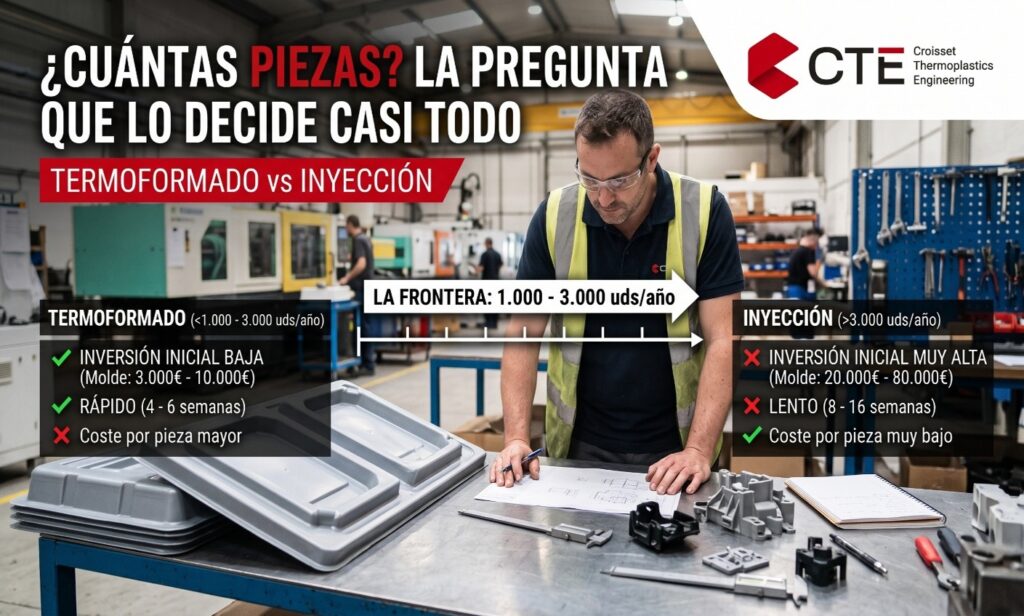
If you need just a few parts, thermoforming is usually the better choice. If you need a lot, injection molding is the way to go. The cutoff point is, in many cases, between 1,000 and 3,000 units per year.
That’s the short answer. But the exact number depends on the part’s size, its geometry, and how confident you are in the design. In this article, we’ll explain how to do the math for your specific situation.
Two technologies, two approaches
Thermoforming. We start with a sheet of plastic. We heat it, form it over a mold using vacuum or pressure, and trim it, usually with a CNC machining center. The mold works on one side only and can be made of resin, aluminum, or engineered wood.
Injection molding. The plastic is melted and injected at high pressure into a closed steel mold, consisting of two halves that define all the surfaces of the part. Each cycle lasts a few seconds, and the part emerges fully formed.
The fundamental difference is simple. Injection molding requires a large initial investment but results in very low production costs later on. Thermoforming requires little initial investment but maintains a slightly higher cost per part.
The mold: this is where the major cost difference lies
An injection mold for a medium-sized technical part easily costs between €20,000 and €80,000. For large parts, the cost can exceed €100,000. In addition, manufacturing the mold typically takes between 8 and 16 weeks.
A thermoforming mold for that same part typically costs between €3,000 and €10,000. And it can be ready in 4 to 6 weeks, including samples.
That mold has to be amortized. If you spread the cost over 200 parts, each one bears a very large share of the cost. If you spread it over 20,000, it’s barely noticeable. That’s why volume is key.
These are rough figures. Each project is budgeted based on the number of parts, materials, and tolerances.
An example with numbers: where the curves intersect
Let’s consider a technical housing measuring approximately 600 × 400 mm. Let’s assume a thermoforming mold costs €4,000 and the price per part is €45. In injection molding, a mold costs 40,000 € and the price per part is 12 €.
| Units | Thermoforming (€/piece, mold included) | Injection molding (€/piece, mold included) |
|---|---|---|
| 50 | 125.00 | 812.00 |
| 250 | 61.00 | 172.00 |
| 1.000 | 49.00 | 52.00 |
| 2.000 | 47.00 | 32.00 |
| 5.000 | 45.80 | 20.00 |
In this example, the curves intersect at around 1,100 units. Below that point, thermoforming is much cheaper: for 250 pieces, it costs nearly one-third as much. Above that point, injection molding begins to become cost-effective.
Illustrative example. Actual prices depend on the material, thickness, die-cutting, and finishes.
Beyond volume: four other criteria
Part size. The larger the part, the more expensive the injection mold becomes, and the greater the advantage of thermoforming. Housings, covers, trays, or panels larger than half a meter are ideal for thermoforming.
Geometry and detail. Injection molding reproduces ribs, clips, threads, and variable wall thicknesses in a single operation. Thermoforming provides good control over one side of the part and handles holes and windows through subsequent CNC machining. If your part requires fine detail on both sides, injection molding has the advantage.
Lead time. With thermoforming, you can have parts in 4 to 6 weeks. With injection molding, the mold alone can take several months. If you’re launching a product or need to switch suppliers quickly, lead time is a critical factor.
Design stability. Modifying a thermoforming mold is quick and inexpensive. Modifying a steel injection mold is not. If the design is still subject to change, start with thermoforming and switch to injection molding once the product is finalized.
The rule of thumb
- Fewer than 1,000 pieces per year, medium or large parts: thermoforming.
- More than 3,000 pieces per year, small parts with a lot of detail: injection molding.
- For quantitiesin between, or if the design is still undecided: compare the two quotes side by side. Or start with thermoforming and switch to injection molding when the volume warrants it.
Not sure? We’ll help you decide
At CTE, we work with two technologies: thermoforming, injection molding, machining, and extrusion of engineering thermoplastics. We’ve been manufacturing custom parts since 1954, and we specialize in short runs.
We have no interest in selling you a specific technology. Our goal is to ensure your part turns out right at the best possible cost. Send us your drawing or a photo of the part, and we’ll tell you which option is best for you.